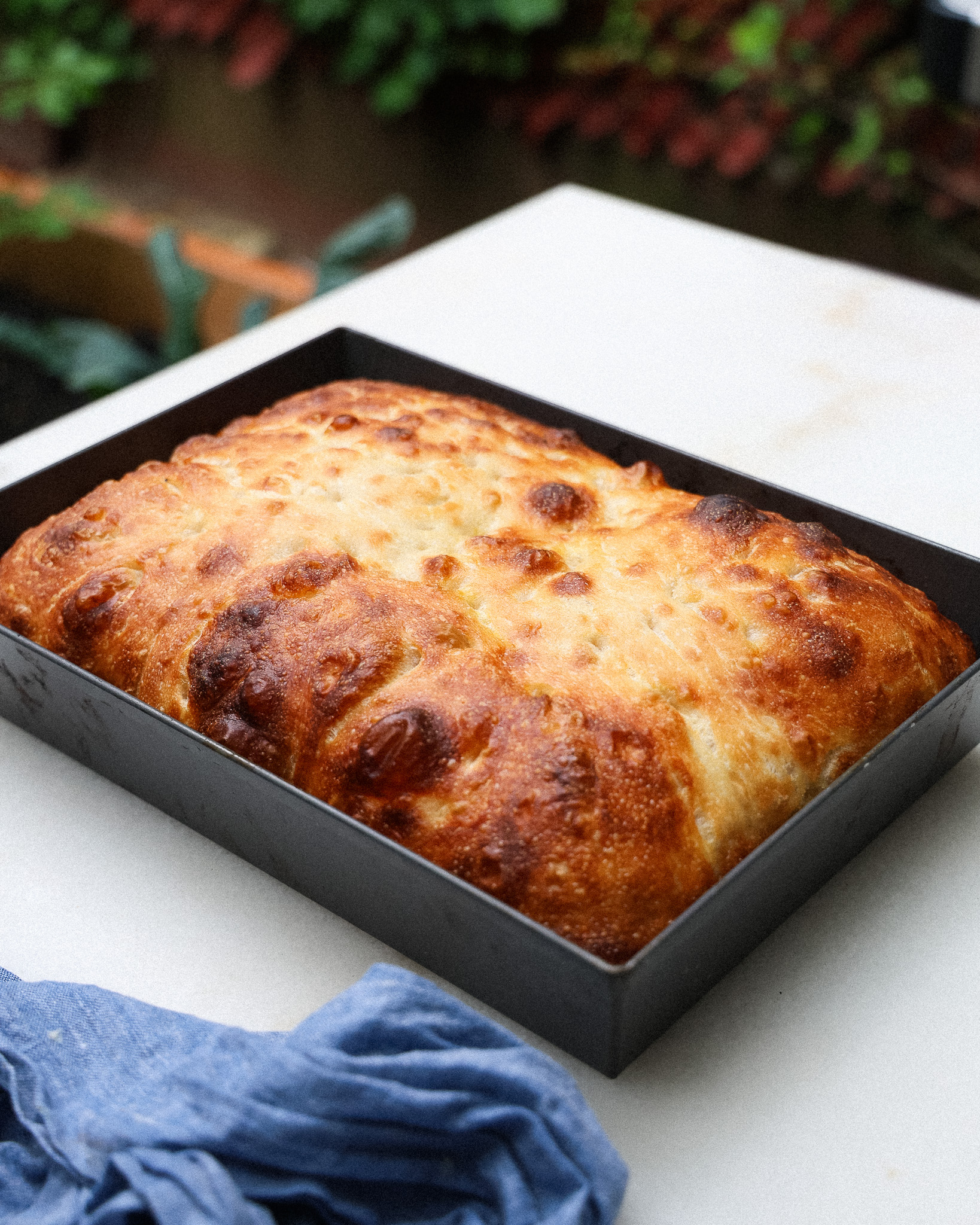
Servings: 10 inch x 14 inch Detroit Style Pizza Pan (12 servings)
Equipment
- 1 stand mixer or hand mixer (this recipe cannot be done without one, unfortunately)
- 1 quarter sheet pan I use Lloyd Pans
Ingredients
For the levain (see Note)
- 50 grams sourdough starter
- 50 grams bread flour
- 50 grams cool water
For the focaccia dough (see Note*)
- 750 grams bread flour, I like King Arthur brand
- 600 grams warm water, 78-85°F
- 150 grams active levain (ie. the mixture above)
- 2 grams active dry yeast
- 15 grams Diamond Crystal kosher salt
- 15 grams granulated sugar
- 75 grams warm water, 78-85°F
For baking the focaccia
- 1/2 cup extra-virgin olive oil
- 2 teaspoons flaky salt
Instructions
- Start the dough the day before you plan to bake. About 4-6 hours before you plan to begin the dough, mix the levain. Mix together 50 grams of rested sourdough starter, 50 grams of bread flour and 50 grams of cool water. Let this activate until doubled in size and very bubbly, about 4-6 hours.
- When the levain is bubbly and doubled in size, begin mixing the focaccia dough. Start with an autolyse: in the bowl of a stand mixer, mix together the 750 grams of bread flour and 600 grams of warm water. Cover with a damp towel and let rest for 30 minutes.
- Add in the 150 grams of active levain, 2 grams of active dry yeast, 15 grams of salt, 15 grams of granulated sugar, and 75 grams of warm water.
- Using the hook attachment on the mixer, mix on medium speed for ten minutes. The dough will look like a batter. Stop the mixer and scrape down the sides.
- Here is where it gets a bit annoying, but it is so worth it in the end. Continue to mix on medium high speed for 10-15 minutes. I suggest letting it run on your counter and leaving the room for a bit - it can feel like a long amount of time! The dough will go from wet batter consistency to tacky and pulling away from the sides. Come back for the last few minutes, and if it needs a bit of encouragement, turn the mixer up to its highest setting. Trust the process, this is my least favorite part, too.
- When you can reach in and stretch up the dough with your hands, then it is time to transfer to the pan you are baking it in. Make sure the pan is at least 2.5 inches deep.
- Begin the first series of "slaps and folds." Using a damp hand, lift the dough up completely, then "slap" it down on itself and gently fold it toward you so that it rests into a mound. Repeat this again, and as you slap and fold you'll start to see the dough gain more structure. Repeat until you have a tight mound of dough in the center of the pan. Cover with a damp towel and let rest for 30 minutes.
- After 30 minutes, repeat the slaps and folds again. Cover and repeat this step two more times, for a total of four rounds of "slaps and folds." This is building up gluten and dough elasticity.
- After the last slap and fold, transfer the dough to the fridge and let it proof for 12 hours up to overnight.
- The next day, remove the dough from the fridge and let it come to room temperature, about 2 hours. It should have relaxed out to all sides of the pan and be very bubbly.
- Gently scoop the dough out of the pan and set it to the side. Coat the pan in 1/2 cup of olive oil. Add the dough back in, then "stitch" it up the center like you would a sourdough (see Note**). Cover and let the dough proof another hour and a half, or until it has fully relaxed to the edges of the pan and is bubbly.
- Preheat the oven to 550°F. (Or as high as it can reach to that point).
- When the dough is ready, dab your fingers in a little of the olive oil pooling at the edges, then dimple the dough, pressing all the way to the bottom of the pan.
- Sprinkle the top of the dough with flaky salt and bake for 18-19 minutes or until dark golden on top. You'd rather this be a little darker on top than light.
- Remove from the oven, let it cool to the touch before removing it from the pan. Slice, and serve!
Notes
Note: For the levain, this mixture makes only enough for one focaccia loaf. Make sure you keep some of your sourdough starter to the side so that you can continue to bake future recipes with it.
Note*: For a thinner focaccia (like the photo with sliced focaccia) use half of this recipe. For a thicker focaccia (like the photo with the focaccia in the pan), follow the amounts as written.
Note**: To "stitch" a loaf, stretch it into a rectangle. Take a pinch of dough on one side of the rectangle and pull it over to the opposite side, use your other hand to take a pinch of dough from that side and pull it over to the opposite side. Continue this, "stitching" all the way down the rectangle. When you've reached the end of the rectangle, roll up the dough so that all the stitches are encased and the dough is very tight. The olive oil will make this tricky, so if it's not perfect, don't sweat it! See the blog images for more help.